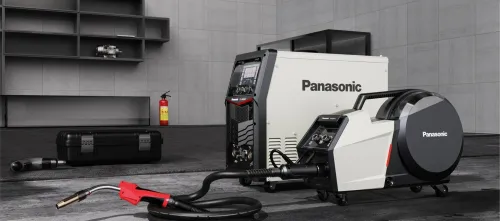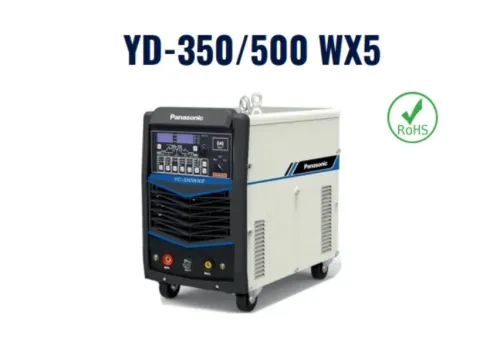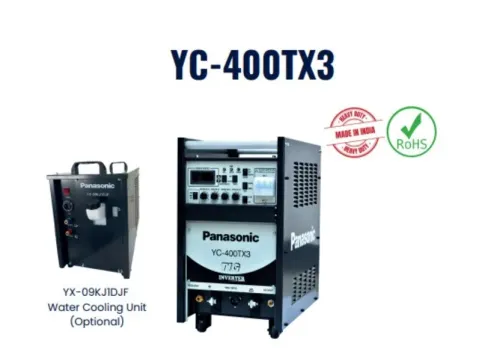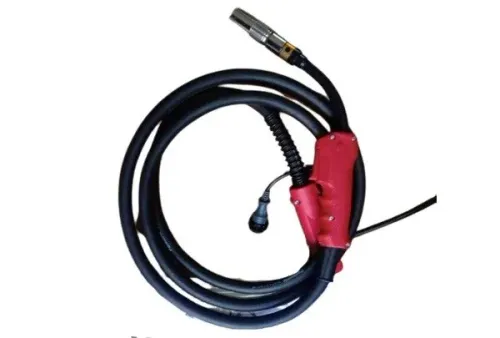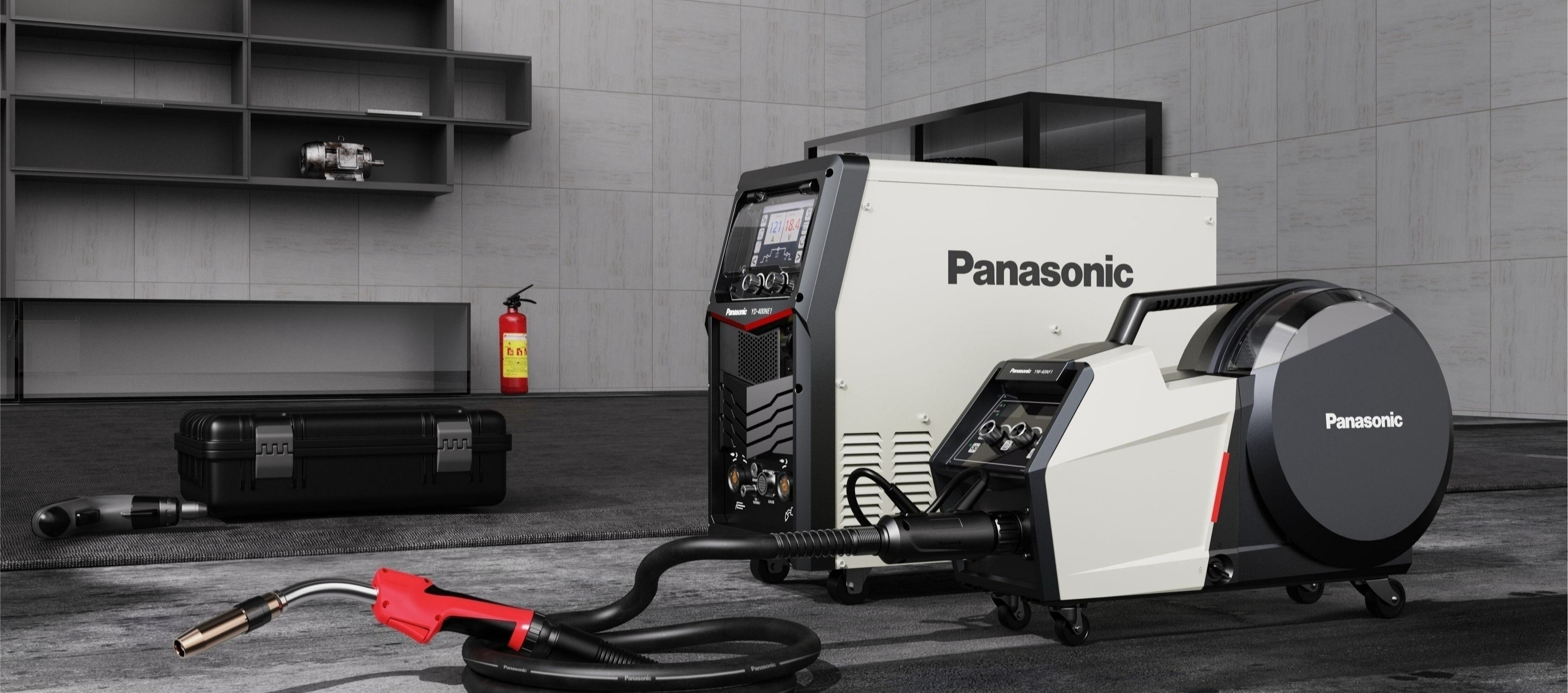
A heavy-fabrication shop needs more than a 350 A or 400 A label: it needs the right transfer mode, gas, wire, duty cycle, cables and service support for its actual joints. By the end, you can compare MAG with other processes, calculate usable production capacity and specify a Panasonic system that suits Pune workshop conditions.
Key takeaways
- Use pure CO2 for economical penetration and argon-CO2 for cleaner transfer.
- Match wire diameter, transfer mode and gas flow to joint thickness and position.
- Check duty cycle, input protection and generator compatibility before installation.
- Compare service response, spare parts and consumable supply—not only machine price.
What solid-wire CO2/MAG welding does for heavy fabrication
ISO 4063 process 135 is solid-wire MAG welding: a feeder pushes continuous solid wire through a torch while active shielding gas protects the arc and molten pool. Pure CO2 gives forceful penetration at low gas cost; an argon-CO2 blend gives smoother transfer, less spatter and easier cleanup.
“panasonic co2 mag for welding machine” means this complete setup—power source, feeder, torch, gas controls, cables and wire—not the power source alone.
The co2 mag machine benefits heavy fabrication buyers measure include fewer interruptions than SMAW electrode changes, higher productive arc-on time, useful deposition rates, controllable arc behaviour, reduced slag removal and repeatable long welds. It suits carbon-steel frames, bases and assemblies with consistent joints.
MAG loses its advantage in wind, which disperses shielding gas, and on rusted or painted steel. It is less portable than stick welding, offers weaker thin-sheet control than TIG and depends on a feeder, torch and gas supply.
| Option | Advantage | Limitation |
|---|---|---|
| SMAW | Portable and tolerant of wind and dirty steel | Electrode changes and slag reduce speed |
| TIG | Precise control on thin material | Slow deposition |
| Flux-cored arc welding | Better outdoor performance and high deposition | More fumes and slag |
| Transformer-rectifier MAG | Rugged, simple power source | Heavy and less responsive |
MAG is faster for long indoor runs; choose flux-cored welding outdoors and TIG for delicate thin sections.
Choose transfer mode, wire, gas and settings for the joint
Set operating parameters from plate thickness, material grade, joint design and welding position—not from the machine’s maximum amperage. Match wire diameter, wire-feed speed, voltage, inductance or arc trim, DCEP polarity and gas flow to that joint; inverter IGBT MAG welding improves response, but it does not choose settings for you.
Gas choice affects penetration, spatter, arc stability, bead appearance, cleanup and operating cost.
| Transfer mode | Use | Gas and limits |
|---|---|---|
| Short-circuit | Root runs, positional welding and thinner sections | Sensitive to wire-feed speed, voltage, inductance and contact-tip distance |
| Globular | Carbon-steel work where low gas cost matters | Pure CO2 gives forceful penetration but higher spatter and rougher transfer |
| Spray | Thick plate, suitable current and larger wire | Requires argon-rich gas; increasing voltage alone will not create spray transfer on pure CO2 |
- Protect the arc with draught screens during Pune monsoon air movement. Do not cure porosity by excessive flow: turbulence entrains air, while low flow, leaks or wind contaminate the weld.
- With liquid-CO2 withdrawal, regulator icing or freezing causes falling flow, porosity and an unstable arc. Separate gas faults from machine faults by checking cylinder pressure, torch flow, leaks, diffuser blockage and weld response on a known-good supply.
- For compatible mild steel, verify ER70S-6 against AWS A5.18. Choose diameter against current, use DCEP, and reject damp, rusty or contaminated wire; it causes porosity, unstable feeding and defective welds.
Match output, duty cycle and electrical installation to Pune conditions
A 400 A nameplate does not mean 400 A production. Read output with rated voltage, duty cycle, test ambient and arc-on time: 60% means 6 minutes welding in each 10-minute period at the stated current. Lower current may increase capacity; Pune heat, blocked airflow, long extensions and voltage drop reduce it.
Record weld minutes, repositioning, cleaning and other stops. Calculate weld minutes ÷ observation period × 100, then compare the required percentage with the manufacturer’s rating at your current and voltage.
| Rating | What it proves | What it does not prove |
|---|---|---|
| 350 or 400 A | Nominal maximum output | Sustained production at that current |
| 60% duty cycle | Six welding minutes in ten at the test point | Performance in a hotter, restricted installation |
| 380–415 V, three-phase | Required supply range | Stable operation through an unsuitable generator |
Check phase balance, earth continuity, generator capacity and input-cable sizing. Select 35, 50, 70 or 95 sq mm welding cable by current, length, allowable voltage drop, heat build-up and duty cycle—not catalogue size alone.
Inverter IGBT MAG welding uses high-frequency switched power conversion to reduce weight and improve input and arc-response control; IGBT technology alone proves neither weld quality nor energy savings. Heavy engineering welding equipment still needs commissioning:
- Check the torch liner, contact-tip size, drive-roll profile, gas leaks, regulator setting, polarity, cable length, return-clamp contact and wire-feed alignment.
Control weld quality, consumables, cooling and total operating cost
Prove productivity with a baseline weld, then record arc-on time, spatter-cleaning time, wire and gas consumption, thermal trips and repair rate. These measurements reveal CO2 MAG machine benefits more reliably than maximum amperage in heavy-engineering welding equipment.
- Porosity: check cylinder contents, contaminated wire, leaks, blocked diffuser, draughts and insufficient or excessive gas flow.
- Undercut, burn-through or uneven bead profile: check contact-tip-to-work distance, voltage, wire-feed balance and travel speed.
- Burnback or failed arc starts: check tip wear, polarity, return-clamp contact and voltage/feed balance.
- Excessive spatter: check transfer settings, inductance, gas turbulence and nozzle cleanliness.
- Bird-nesting: replace a damaged liner, correct inlet-guide alignment and set drive-roll pressure; replace liners and tips during preventive maintenance.
| Torch choice | Benefit | Cost or risk |
|---|---|---|
| Air-cooled | Suits modest duty and shorter welds | Lower complexity |
| Water-cooled | Handles high amperage, long arc-on time and large wire | Pump, hoses, coolant checks and leak failures |
| Either | Match the torch rating to measured duty cycle | Incorrect cooling adds cost without productivity |
Model total cost from electricity, wire, shielding gas, tips, liners, nozzles, anti-spatter, torch wear, downtime, calibration, operator skill and repairs. Provide local exhaust extraction, ventilation and respiratory controls; CO2 accumulation can create oxygen deficiency. Pressure vessels and safety-critical assemblies require a qualified procedure, approved consumables, qualified welders and code-specified inspections.
Compare Panasonic machine types by the work they must sustain
A nominal 350 A or 400 A rating proves little. Compare output at the required duty cycle, input demand, wire-diameter range, feeder regulation, transfer mode, torch rating, cooling, portability and bead quality on the actual joint before selecting a Panasonic welding machine in Pune.
| Option | What to compare | When it fits |
|---|---|---|
| YD-350GZ4 | Rated production envelope, feeder control, torch duty and cooling | Frames and assemblies whose current, wire size and arc-on time stay within its rating |
| YD-400RX | Usable current range, three-phase site supply and long-lead performance | Long welds that need stable voltage, not merely its headline output |
| Transformer-rectifier MAG | Rugged simplicity versus greater size and weight | Harsh, fixed fabrication bays where portability and fine arc response matter less |
| Inverter or pulse MIG/MAG | Smaller size, input control and arc response; pulse adds controlled transfer, lower spatter, appearance and heat control | Positional or appearance-critical work only when those gains repay added complexity |
Run a rental or trial on representative frames, bases or assemblies. Record arc-on time, spatter-cleaning time, wire and gas use, thermal trips and weld-repair rate. Define heavy-engineering welding equipment as the complete package: power source, feeder, torch, gas controls, cables, return lead, required cooling and compatible consumables.
Specify local supply, service and support before buying in Pune
A dependable installation starts with written local support, not maximum amperage. Before buying a Panasonic welding machine in Pune, ask the supplier to confirm:
- Stock of Panasonic torches, contact tips, liners, drive rolls, cables, spare boards and cooling-unit parts
- Breakdown response time, rental or replacement options, calibration support and on-site diagnosis of wire-feed, gas-flow and inverter faults
Require a written commissioning record covering input voltage, phase balance, earth continuity, measured gas flow, polarity, cable heating and feeder operation. Have the supplier weld a representative sample and inspect it against your shop’s acceptance criteria.
| Evidence | Accept | Reject |
|---|---|---|
| Service | Named response time and technician | “Support available” only |
| Trial | Arc-on time, cleaning time, wire/gas use, trips and repair rate recorded | Open-circuit voltage comparison |
| Spares | Local availability and lead times | Unpriced, unconfirmed supply |
A search for “Panasonic CO2 MAG for welding machine” should end with a complete package, not a power source alone. Weld Tech Corporation, a Pune-based supplier, wholesaler and rental provider, can assemble the machine, torch, consumables and gas controls, arrange a trial or replacement path, and support Panasonic equipment after delivery.
Compare those records, training and measured results.
Choose standard MAG for continuous carbon-steel fabrication; pulse MAG when transfer control repays its cost; and another process when wind, contamination, extreme thinness or non-ferrous work makes MAG unsuitable.
Related products
 | MAG Welding Machines Panasonic MAG Welding Machines Brand Panasonic Model YD-350GZ4 Phase 3-Phase Current 350 A Voltage 380-415 V Dimension (L x B x H) 380x550x640 mm Product Type New Duty Cycle 60%... View product → |
 | Welding machine Panasonic Inverter Welding Machines Brand Panasonic MODEL YD-400RX 1 INPUT SUPPLY 415 +10% -20% PHASE THREE /50-60HZ POWER CONSUMPTION 16.2KVA/15.6KW WELDING CURRENT RANGE 50-400AMP... View product → |
Frequently asked questions
What does solid-wire CO2/MAG welding do for heavy fabrication?
ISO 4063 process 135 uses a continuous solid wire and shielding gas. Pure CO2 provides forceful penetration at low gas cost, while argon-CO2 blends reduce spatter and cleanup.
How do you choose wire, gas and settings for a MAG joint?
Select wire diameter and grade for the base metal, then choose transfer mode, voltage, wire-feed speed, polarity and gas flow for the joint thickness, position and required bead profile.
What should you check before installing a MAG machine in Pune?
Confirm rated output and duty cycle, available single- or three-phase supply, earthing, cable sizing, protection from voltage variation, ventilation and compatibility with the site generator.
How can you control the operating cost of a CO2/MAG machine?
Track wire, gas, contact tips, liners, nozzles, electricity, rework and downtime. Correct settings, clean liners, adequate cooling and dependable local service reduce avoidable cost.
Related products
 | CO2 welding machine Inverter IGBT-Controlled CO2/MAG Welding Machine Advanced arc stability for high-quality welds Flexible parameter settings for materials & thicknesses Robust build for long-term durability in... View product → |
 | MAG Welding Machines Full Digital Controlled Pulse MIG/MAG Welding Machine Root Welding control technology IBC (The Arc Ignition & Burn Back Control) Pulse Constant Arc Length Control, ALC (Arc Length Consistence) HL-Pulse... View product → |