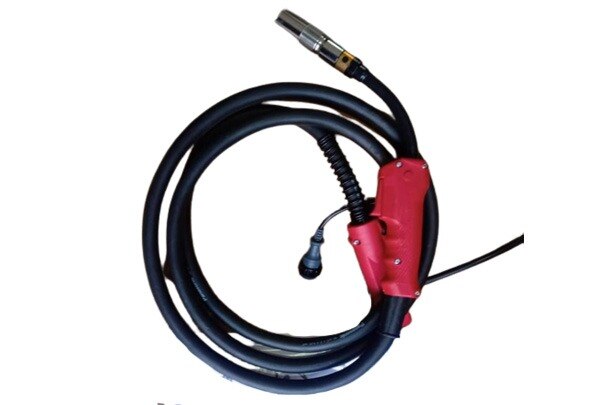
A failed contact tip can be a worn consumable, but it can also expose a feeding, gas-shielding, electrical or torch-cable fault. You will be able to isolate the machine safely, identify the real cause, decide between repair and rental, and verify that a replacement torch will work before accepting it.
Key takeaways
- Stop the power source and isolate wire feed before removing burned-back wire.
- Check liner blockage, drive-roll pressure, wire size, and gas flow before replacing the tip.
- Rent a replacement torch when production downtime exceeds the repair time.
- Confirm connector, trigger wiring, liner, contact tip, and torch rating before acceptance.
What to do immediately when the contact tip fails
Stop welding immediately. Release the torch trigger, switch off the welding power source, and isolate the wire-feed system before cutting away wire that has burned back into the contact tip. Do not force seized wire through the torch; you can damage the liner and create a second feeding fault.
- Photograph the contact tip and torch connection before disassembly. Remove the nozzle and inspect the tip for an enlarged or oval bore, spatter blockage, incorrect bore size, looseness in the diffuser, or overheating.
- Check the tip holder, diffuser, nozzle opening, liner entrance, conductor tube and drive-roll path for fused wire, impact marks and debris. Inspect shielding-gas parts too: a blocked nozzle, damaged diffuser, loose connection or restricted hose can cause porosity.
- Record the machine make and model, wire type and diameter, contact-tip size, voltage and wire-feed settings, shielding gas, stick-out and the appearance of the failure. Note whether the arc was unstable beforehand.
- Identify the event as burnback, wire seizure, erratic arc starts, bird-nesting or tip overheating. Include any unusual cable heating or intermittent trigger response.
This torch recovery after welding faults separates a failed consumable from damage that will destroy the next tip. Give the record and photographs to the rental provider so they can decide between a bare torch and a complete gun-and-consumables kit.
How to identify the fault behind a failed contact tip
A failed contact tip is not automatically a defective tip; identify whether the failure began in the gas path, wire feed, torch position or electrical circuit.
| Symptom | Likely cause | Check |
|---|---|---|
| Burnback or seized wire | Tight bore, excessive stick-out, liner drag or overheating | Compare tip size with wire, inspect liner and measure the procedure’s specified stick-out |
| Bird-nesting | Dirty or kinked liner, excessive drive-roll pressure or mismatched groove | Check liner alignment, reduce pressure and match the groove to wire diameter |
| Porosity after fitting a new tip | Blocked nozzle, damaged diffuser, restricted gas hose or loose connection | Clean the nozzle, inspect the diffuser and confirm gas flow and connections |
| Erratic arc or tip overheating | Oversized bore, loose tip, poor continuity, trigger fault or damaged connector | Check tip fit, trigger, cable insulation, central connector and continuity |
Compare the installed tip with the actual wire. Solid steel, stainless, aluminium and metal-cored wires can require different tip materials and clearances: a tight bore can seize as the wire and torch heat up, while an oversized bore causes arc instability.
Excessive stick-out raises resistance and promotes burnback; too little distance invites tip-to-work contact and spatter damage.
For aluminium, inspect the low-friction liner or linerless setup, suitable drive rolls and a short, straight torch path. An aluminium tip alone will not cure bird-nesting. Correct the failed condition before fitting a replacement torch for workshop repairs or installing another tip.
When should you repair the torch, and when should you rent one?
A worn, loose, blocked or heat-damaged contact tip, nozzle, diffuser or liner needs a consumable-level repair when the cable, neck, handle, trigger and machine connector remain sound.
Do not keep welding if insulation has melted, conductors are exposed, trigger wiring cuts in and out, the central connector is damaged, the neck is cracked or the cable shows heat damage.
| Damage | Correct decision | Reason |
|---|---|---|
| Consumable only | Replace the tip, nozzle, diffuser or liner | The torch body and electrical path remain sound |
| Repairable torch damage | Stop using it and arrange professional repair | Exposed conductors, faulty trigger wiring or damaged connections create shock and short-circuit hazards |
| Severe or time-critical damage | Use a replacement torch for workshop repairs or rent one | Production can continue while the original torch is assessed or repaired |
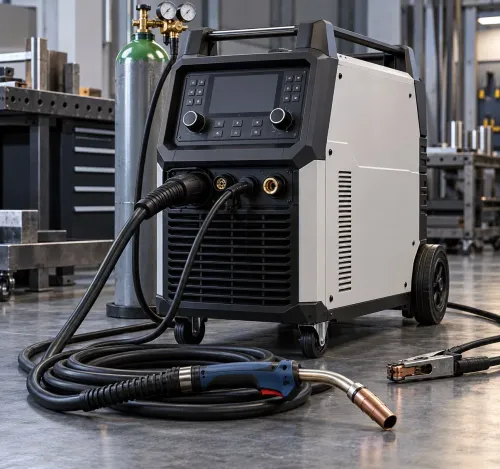
Match the replacement torch to the welding procedure, not amperage alone. Check current rating, stated duty cycle, shielding-gas condition, cable length, neck angle, conductor-tube thread, diffuser, liner type and machine connector; a high-current torch can still overheat when operated continuously beyond its duty cycle.
Air-cooled and water-cooled torches are not interchangeable by amp rating. A water-cooled rental is unsuitable without the cooler, hoses, correct coolant connections and flow protection. Check the manufacturer’s coolant requirements and machine connection rather than assuming a universal flow or temperature limit.
Renting makes sense when production must continue during repair. Do not use a rental to hide a wire-feed or power-source fault, or the replacement torch will fail as well.
How to verify a hired MIG torch will fit your welding system
A torch that plugs in is not necessarily a torch that will weld. Before accepting a hire, send the provider the machine make, model, polarity and clear photographs of the machine-side socket.
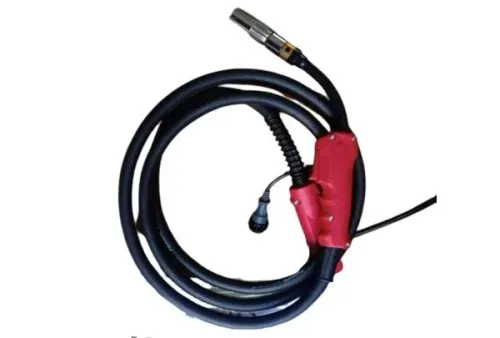
1. Confirm whether the torch uses a Euro connector, a machine-specific plug or an adaptor. Verify the trigger wiring and pinout; a connector that fits mechanically can still give no trigger signal or damage the control circuit.
2. Match the gas connection, wire-feed drive arrangement, liner length, contact-tip thread, diffuser, torch length and neck angle. Confirm the wire diameter range, rated amperage and duty cycle against your welding procedure, not just the machine’s brand.
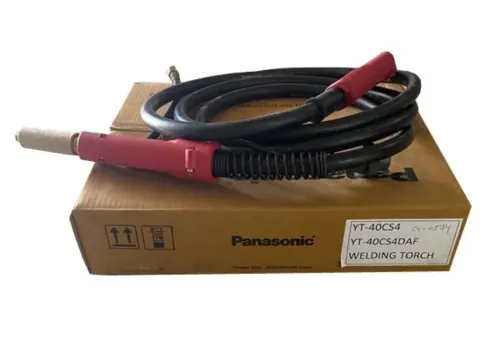
3. State whether you need a bare torch, a complete gun-and-consumables kit or a torch for an existing Panasonic welding system. Panasonic and other manufacturers use different machine-side connections and consumable geometries, so a brand name does not prove interchangeability.
4. Ask for the included tip sizes, liner, spare diffuser and the torch’s pre-hire condition record. Require the connector and consumables specification in writing before dispatch.
For buyers comparing MIG torch hire in Ahmedabad, Weld Tech Corporation can confirm whether the request is an actual rental, replacement sale or short-term equipment arrangement; published supply or distribution information alone does not establish rental availability. A written specification should also record polarity, torch length, wire range, amperage and duty cycle.
Related products
 | MIG Welding Torch We are Manufacturer, Distributor, Supplier of MIG Welding Torches, MIG Welding Torch View product → |
 | MIG Welding Torch We are Manufacturer, Distributor, Supplier of MIG Welding Torches, MIG Welding Torch View product → |
What acceptance checks prevent a second welding failure?
Test the rental torch before production, not after the first arc fails. Torch recovery after welding faults starts with a physical, electrical and gas-delivery check.
1. Inspect the nozzle, neck, handle, cable sheath, insulation, central connector and gas hose for cuts, cracks, burn marks and loose parts. Reject the torch if conductors show through or insulation is heat-damaged.
2. Confirm that the contact tip matches the wire diameter and material. Check the diffuser thread and liner entrance for fused wire, damaged threads, impact marks or debris.
3. Isolate the machine and wire-feed system, then confirm that the wire path is clear and the liner reaches the diffuser correctly. Test the trigger, any torch gas valve, continuity and the machine-side connector before striking an arc.
4. Connect shielding gas and check the hose for restriction, fittings for looseness and the diffuser for leaks. Clean a spatter-clogged nozzle; poor shielding can create porosity that is wrongly blamed on the replacement tip.
5. Run a controlled feed test with the torch as straight as the job allows. Make a short weld at the procedure’s specified stick-out and settings, watching for burnback, bird-nesting, erratic starts, cable heating and unstable shielding.
Stop immediately if conductors, connectors or insulation heat abnormally. For mig welding for torch rental services in ahmedabad, record the machine connector, polarity, wire range, current rating, duty cycle, torch length, liner, tip sizes and included spare diffuser and contact-tip pack. That specification verifies compatibility instead of accepting a visually similar gamble.
Frequently asked questions
What should you do immediately when a MIG contact tip fails?
Release the trigger, switch off the welding power source, isolate the wire feeder, and remove burned-back wire without forcing it through the liner.
How can you identify the fault behind a failed contact tip?
Inspect for liner blockage, incorrect contact-tip size, excessive drive-roll pressure, poor wire condition, feeding resistance, and inadequate shielding gas flow.
When should you repair a MIG torch instead of renting a replacement?
Repair the torch when the fault is limited to a replaceable tip, liner, diffuser, or cable component; rent when repair time threatens production or the torch has broader damage.
How do you verify that a hired MIG torch fits your welding system?
Match the torch connector, trigger wiring, liner, contact-tip thread and size, wire diameter, cable length, cooling method, and current rating with the system.
What acceptance checks help prevent another welding failure?
Test wire feeding, trigger operation, gas flow, cable movement, connector seating, contact-tip alignment, and a trial weld before returning the torch to production.
Related products
 | Mig Torch We are Manufacturer, Distributor, Supplier of MIG Welding Torches, MIG Welding Torch View product → |
 | Welding Spare Parts We are Manufacturer, Distributor, Supplier of Welding Spare Parts View product → |