An inverter-controlled DC arc welding machine converts incoming AC power into closely regulated direct current for manual metal arc welding. By the end, you will know how its power circuit works, how polarity and electrodes affect the weld, where it fits in maintenance work, and what to verify before connecting or renting one in Hubballi.
Key takeaways
- An inverter welder converts AC to controlled constant-current DC for MMAW.
- Match electrode type, diameter and polarity to the base metal and weld position.
- Check input supply, output leads, duty cycle, cooling and earth connections before use.
- Use inverter DC arc welding for repair and maintenance when portability and control matter.
How an inverter-controlled DC arc welder produces welding current
An inverter DC arc welding machine is a constant-current power source for MMAW or SMAW electrodes. It accepts incoming AC, rectifies it into DC, switches that DC at high frequency through IGBT devices, passes it through a compact high-frequency transformer, then rectifies and controls the output as adjustable welding current.
The power path matters in an arc welding machine explained for production maintenance because it determines portability, input demand and sensitivity to site conditions.
| Power path | What happens | Practical result |
|---|---|---|
| Inverter DC welder | AC input is rectified, switched at high frequency, transformed, rectified again and electronically regulated | Smaller, lighter equipment with responsive current control |
| Transformer AC welder | Line-frequency AC passes through a large transformer that lowers voltage and raises current | Rugged, simple construction but greater weight and less compact transport |
| Transformer-rectifier DC welder | A transformer lowers the AC voltage, then diodes or a rectifier convert it to DC | Stable DC output, but a larger and heavier machine than an inverter |
A conventional transformer changes voltage directly at the supply frequency, so its transformer needs substantial iron and copper. An inverter uses high-frequency switching to reduce transformer size; its electronics also demand clean ventilation and protection from moisture, conductive dust and severe voltage events.
Do not confuse this inverter DC arc welding machine with a DC generator welder. Both deliver DC, but the generator creates electrical power mechanically, while the inverter processes an external AC supply. Select the machine by usable current range, duty cycle, electrode size and supply requirements—not by a 200 A label alone.
What happens during MMAW: electrode, arc, shielding and polarity
Strike the coated electrode against clean steel, lift it slightly, and the arc melts both the electrode tip and the joint edges. A DC arc welder uses constant current to keep that arc stable while the coating burns, producing shielding gas and a molten slag layer that protect the weld pool from air.
As the rod shortens, stop, allow the pool to settle, chip and brush the slag, then fit a new electrode.
- Set the current within the electrode maker’s range and connect the work return to clean metal close to the joint.
- Select the polarity printed on the electrode packet; matching diameter alone does not make E6013, cellulosic, and E7018 rods interchangeable.
- Keep a short, steady arc and move at a speed that leaves an even bead. A long arc admits air and increases spatter.
- Remove slag between passes. Trapped slag becomes an inclusion and weakens the joint.
| Polarity | Arc behaviour | Use |
|---|---|---|
| DCEP, electrode positive | More heat reaches the electrode; common choice for many low-hydrogen rods | E7018 and other electrodes marked DC+ |
| DCEN, electrode negative | Less electrode heating and a different penetration balance | Use only when the electrode or procedure specifies DC− |
| AC | Alternating current; polarity changes continuously | Use when the electrode is marked for AC |
E6013 commonly runs on AC, DCEP, or DCEN; follow its packet because the formulation sets the usable range. Keep E7018 dry and follow its holding or rebaking instructions. For repetitive fabrication, MIG/MAG or submerged arc welding reduces electrode changes; MMAW suits outdoor repairs, changing positions, and small batches.
Where DC arc welding fits in production maintenance
Choose an arc welding machine for maintenance when access changes, the work is outdoors, or the job involves a few repairs rather than continuous production. DC arc welder uses include carbon-steel and low-alloy-steel brackets, pipe supports, frames, agricultural equipment, stainless-steel repairs, and cast iron with a suitable electrode.
It handles imperfect fit-up and awkward positions better than a high-deposition process.
| Equipment | Main advantage | Maintenance trade-off |
|---|---|---|
| AC welder | Simple output and greater tolerance of some power disturbances | Less arc control and more difficult starts with certain electrodes |
| Transformer-rectifier DC | Robust, steady DC welding current | Heavy, harder to transport, and less convenient on remote jobs |
| MIG/MAG | Continuous wire and high deposition for repetitive joints | Needs shielding gas, cleaner material, and controlled access |
| TIG | Precise, clean welds on thin stainless steel and critical joints | Slow, skill-intensive, and poorly suited to heavy repair volume |
| Inverter DC arc welder | Portable, adjustable current for changing positions | Electrode changes interrupt work, and electronics need clean, dry ventilation |
Select the inverter MMA machine when portability, joint access, and flexibility outweigh deposition rate. MIG/MAG or submerged arc equipment wins in a controlled fabrication bay where long, repeated welds justify wire-feed speed and fewer interruptions.
Check low-current stability as well as maximum amperage. Thin sheet, small repairs, stainless steel, and root passes can demand a steady 40–80 A; 3.15 mm and 4.0 mm electrodes need substantially more current according to their data sheets. A 200 A label alone does not predict useful production performance.
How to choose electrodes, current, supply and duty cycle
Choose the electrode from the joint, not from the machine’s maximum amperage. A 2.5 mm electrode suits many thin sections and root repairs; a 3.15 mm or 4.0 mm electrode deposits more metal but demands higher current, adequate thickness and a supply that will not trip.
| Electrode diameter | Typical current starting point | Check before welding |
|---|---|---|
| 2.5 mm | 60–90 A | Thin material, root passes and small repairs |
| 3.15 mm | 90–130 A | Medium sections and general fabrication |
| 4.0 mm | 130–180 A | Thicker joints with enough heat tolerance |
Use the electrode manufacturer’s data sheet to set the final range. Reduce current for vertical or overhead work; excessive current causes undercut, spatter and a fluid weld pool. Stable operation around 40–80 A matters for thin sheet, small repairs and some stainless-steel work.
A 60% duty cycle at 160 A means six welding minutes in a ten-minute period at the stated test conditions, followed by four minutes of cooling. It does not mean the machine can deliver its advertised maximum continuously.
Read the nameplate for 230 V single-phase or three-phase input, rated input current and allowable voltage range. The phrase arc welding machine in Hubballi identifies a location, not supply compatibility. Use leads rated for current, length and duty cycle; never coil damaged or undersized leads. Clamp the return to clean metal near the joint.
Choose a generator from the manual’s minimum rating, allowing for input current, efficiency, power factor, inrush and voltage stability—not the 200 A output label. This is the practical standard for an arc welding machine explained for production maintenance.
What to check before using, renting or servicing the machine
A machine is ready for production maintenance only when its actual input, output and condition match the job—not when its front panel shows a high maximum amperage. Check the supply, cables, ventilation, duty cycle and recent service record before striking an arc.
1. Read the nameplate and manual. Confirm 230 V single-phase or 415 V three-phase supply, 50–60 Hz, input tolerance and protective-device requirements. Do not connect a three-phase machine to an assumed site supply.
2. If you use a generator, verify continuous kVA capacity, voltage and frequency regulation, waveform compatibility and earthing in the manual. Peak kVA alone does not prove compatibility.
3. Inspect the electrode holder, work clamp, welding leads, plug, terminals and insulation. Reject cracked insulation, loose lugs, overheated connectors or a clamp that cannot bite clean metal.
4. Check that the fan starts, air passages are clear and no conductive dust, moisture or oil has entered the case. Blocked ventilation can trip thermal protection or damage inverter electronics.
5. Confirm the machine’s usable current and duty cycle for the electrode diameter and repair sequence. A 60% duty cycle means the rated output is available for six minutes in a ten-minute period; exceeding it causes stoppage and heat damage.
6. Strike a test arc on matching scrap, then inspect arc stability, polarity, current control and abnormal noise or error codes. Isolate power before opening the case; internal capacitors can retain dangerous voltage.
For an arc welding machine for maintenance, record the input supply, fault history and inspection date. When renting an arc welding machine in Hubballi, ask Weld Tech Corporation to document those checks and provide the correct leads and service status.
Related product
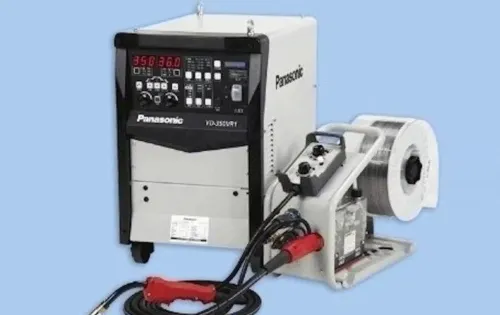
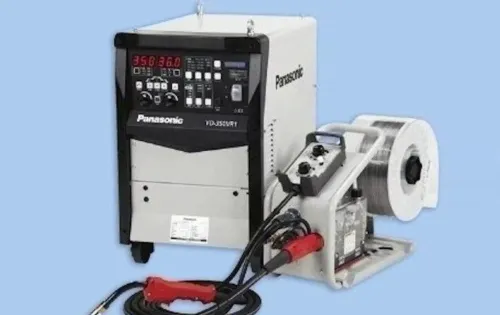
 | DC ARC Welding machine Inverter Controlled DC ARC Welding MODEL YD-400AT3 DJR INPUT SUPPLY 415 + - 20% PHASE / FREQUENCY THREE / 50-60 HZ POWER CONSUMPTION 17.6 KVA/16.7 KW WELDING CURRENT RANGE 20-400AMP... View product → |
Frequently asked questions
How does an inverter-controlled DC arc welding machine produce welding current?
It rectifies incoming AC to DC, switches the DC at high frequency through IGBT devices, transfers it through a compact transformer, then rectifies and controls the welding output.
What happens during MMAW with a DC arc welder?
The electrode carries current to the joint, an arc melts the electrode and base metal, and the electrode coating forms shielding gas and slag. The selected polarity affects arc behaviour and weld penetration.
Where are DC arc welders used in production maintenance?
They suit repair work, structural fabrication, equipment maintenance, plant shutdowns and site welding where a constant-current source and manual electrodes are practical.
How do you choose electrodes, current and duty cycle?
Select the electrode classification and diameter for the material and joint, set current within the electrode maker’s range, confirm the required polarity, and keep the machine within its rated duty cycle.
What should you check before using, renting or servicing the machine?
Inspect the input cable, plug, electrode holder, return clamp, output leads, cooling openings, earth connection, controls and rating plate. Confirm the supply voltage and arrange service when insulation, connectors or cooling components are damaged.