
A Panasonic conical nozzle cannot be selected safely by appearance or welding-machine brand alone. You will need to match the torch interface, gas path, contact-tip position and operating conditions, then verify the part before ordering or installing it.
Key takeaways
- Match the nozzle to the complete torch assembly, not only the power source.
- Choose a conical nozzle when gas coverage and joint access both matter.
- Replace nozzles with damaged threads, blocked outlets, or severe spatter buildup.
- Check gas flow, contact-tip position, liner condition, and settings before blaming the nozzle.
Match the Nozzle to the Complete Torch Assembly
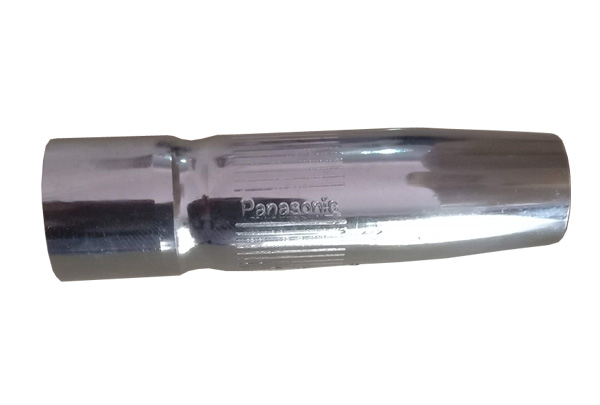
A compatible Panasonic conical nozzle is identified by the complete torch assembly, not the power-source model.
One Panasonic power source can be supplied with different torch models, so record the torch model, Panasonic consumable or spare-part number, wire diameter, nozzle bore and length, thread or push-fit mounting, diffuser or gas-distributor design, and insulating components before ordering welding machine spares.
1. Compare the nozzle with the torch interface, not its appearance. Two nozzles with the same outside diameter can have different internal shoulders, seating dimensions, retaining threads or push-fit methods. A mismatch can leave the nozzle loose, alter gas coverage, or damage the diffuser.
2. Check the internal profile and overall length against the approved torch specification. A different shoulder or length can move the contact tip forward or backward, changing contact-tip stick-out and nozzle-to-work distance. Recheck the welding procedure’s specified stick-out after fitting a replacement.
3. Require the package and invoice to state Panasonic branding where applicable, the exact part number, quantity, bore and length, mounting specification, compatible torch, return conditions, and whether it contains only the nozzle or a complete front-end kit.
4. Confirm dimensions, material grade, applicable standards, stock, warranty and delivery directly with the supplier. Do not infer them from another Panasonic listing, even when it shows a similar MIG nozzle spare part.
Stock industrial welding spares by torch assembly and interface: separate conical nozzles, contact tips, diffusers, liners, insulators, O-rings and torch-neck parts, with each approved part number and wire-size range recorded.
Choose the Conical Shape for Gas Coverage and Joint Access
Choose a conical nozzle when the joint is narrow, the torch needs access around a fillet, and the bore can clear the arc without wasting shielding gas.
The nozzle directs gas around the arc and concentrates coverage over the weld zone; a bore that is too small can touch the contact tip or restrict gas flow, while a large bore adds clearance from spatter and the workpiece but exposes the flow to drafts and turbulence.
| Option | Gas and access effect | When it applies |
|---|---|---|
| Smaller conical bore | Concentrates coverage and reaches tight joints | Fillets, narrow grooves and restricted torch angles |
| Cylindrical | Provides uniform clearance through the opening | General access where concentration is less critical |
| Tapered | Balances entry clearance with a narrowing outlet | Joints needing moderate access and directed flow |
| Standard | Uses the torch maker’s common geometry | Procedures written around a specified standard nozzle |
| Gas-saving | Uses internal shaping to reduce unnecessary flow | Controlled cells with stable torch distance and low airflow |
Select the Panasonic conical nozzle against torch geometry, joint access, transfer mode, shielding-gas type, welding current, ambient airflow and the procedure specification. Start around 10–20 L/min, then verify the procedure value; excessive flow can entrain air at the nozzle outlet and create porosity.
Investigate another geometry when access remains restricted, the torch has unusual geometry, high-spatter work demands greater clearance, or the front-end assembly uses a different nozzle interface. Record the interface before ordering MIG nozzle spare parts.
Inspect the Worn Nozzle and Replace It Without Creating New Faults
Replace the nozzle when the gas outlet is blocked, internal spatter is heavy, the bore is oval or dented, or you find cracks, burn-through, a loose fit, or a distorted mounting face. Do not treat anti-spatter compound as a repair; excess compound can obstruct gas flow or contaminate the contact tip and liner.
- Isolate the welding machine electrically, close or control compressed shielding gas, and follow the machine and torch service instructions. Allow the nozzle, contact tip, and diffuser to cool. Wear heat-resistant gloves and suitable eye protection.
- Remove the nozzle with the approved tool. Do not force a seized hot part; wait for cooling and use the removal method specified for the torch.
- Inspect the diffuser or gas distributor, contact tip, O-ring, insulating washer, retaining thread, and torch neck. Clean spatter without scratching or enlarging the bore.
- Fit the approved welding machine spares part using the specified hand-tightening or tool method. Do not substitute mig nozzle spare parts by appearance alone.
- Confirm that the contact tip is centred and does not touch the nozzle. Check contact-tip stick-out, then restore the specified gas flow.
- Check for leakage at the torch connection, diffuser seal, and nozzle. Apply anti-spatter compound sparingly, keeping it away from the gas opening.
A new conical nozzle cannot correct a damaged diffuser, leaking O-ring, bent neck, or mismatched retaining thread. Stop if the fit is loose or the bore is misaligned.
Diagnose Welding Defects Before Blaming the Nozzle
Porosity is not proof that the nozzle is worn. A reduced gas opening, heavy internal spatter or a poor fit creates uneven gas coverage; an off-centre contact tip can cause an unstable arc, excessive spatter and contact-tip shorting. A leaking seal, bent neck or mismatched diffuser can also overheat the torch front end.
Before increasing flow, inspect gas flow at the torch, listen for leaks, check the regulator and hose, and test for drafts. A new Panasonic conical nozzle will not cure leakage at the torch-hose connection, solenoid, diffuser seal or a cracked neck.
Repeated damage points to a cause, not a service-life limit. Check whether the torch strikes the weld pool, approaches at an excessive angle, uses a high-spatter transfer mode, receives inadequate reaming and cleaning, or has an anti-collision fault.
Genuine Panasonic parts and compatible mig nozzle spare parts differ in practical risk:
| Criterion | Genuine Panasonic | Compatible aftermarket |
|---|---|---|
| Interface accuracy | Designed for the specified torch, diffuser and retaining method | Verify seating, concentricity and dimensions |
| Construction | Confirm copper, brass or plated material and heat resistance | Compare grade, plating and spatter resistance |
| Supply | Check authorised availability | Availability may be broader; confirm return terms |
| Cost | Higher purchase price can reduce fit-related rework | Compare total replacement cost, not price alone |
Treat industrial welding spares as production controls: compare nozzle price with downtime, rework, and a damaged diffuser or torch. A cheaper part is costly if it causes another stoppage.
Order and Stock Welding Nozzle Replacement in Hubballi
For welding nozzle replacement in Hubballi, send the supplier enough evidence to match the complete torch interface before requesting pickup or dispatch.
- Confirm stock before removing the old nozzle. Ask whether local pickup or dispatch is available, then obtain the expected delivery time in writing.
- Photograph the installed nozzle from the front and side, showing its shape, bore and mounting position.
- After removal, photograph the diffuser or gas distributor and torch connection only when the machine is isolated and the parts are cool and safe to handle.
- Capture the torch nameplate or model, not only the Panasonic power-source model.
- Record wire diameter, nozzle bore, nozzle length, mounting style such as thread or push-fit, and required quantity.
- Send the Panasonic consumable or spare-part number shown on the old part, package or service record.
Organise welding machine spares by torch assembly and interface, not by Panasonic machine brand alone. Keep separate records for conical nozzles, contact tips, diffusers, liners, insulators, O-rings and torch-neck components, including approved part numbers and compatible wire sizes.
Weld Tech Corporation can help a Hubballi industrial buyer verify the part, check availability and source related industrial welding spares. Confirm exact compatibility, price, warranty and delivery with the supplier; a visually similar nozzle can still have the wrong shoulder, thread, seating depth or retaining method.
Related product
 | Welding Spare Parts We are Manufacturer, Distributor, Supplier of Welding Spare Parts View product → |
Frequently asked questions
How do you match a Panasonic conical nozzle to a torch?
Identify the complete torch assembly, then check the torch series, nozzle connection, thread or slip-fit design, outlet diameter, and length. The power-source model alone does not identify a compatible nozzle.
When is a conical nozzle the right choice?
Choose a conical nozzle when you need broad shielding-gas coverage while retaining access to a narrower joint or restricted weld area. Check clearance around the joint before fitting it.
When should you replace a welding nozzle?
Replace it when the outlet is distorted or blocked, threads are damaged, the nozzle is loose, or spatter has changed gas flow and cannot be removed safely. Fit the nozzle without forcing the torch parts.
Which faults can look like a bad nozzle?
Porosity and unstable arcs can also come from incorrect gas flow, leaks, drafts, a damaged contact tip, a worn liner, poor stick-out, contaminated material, or incorrect welding settings.