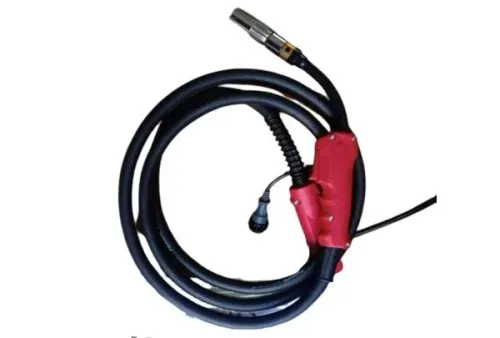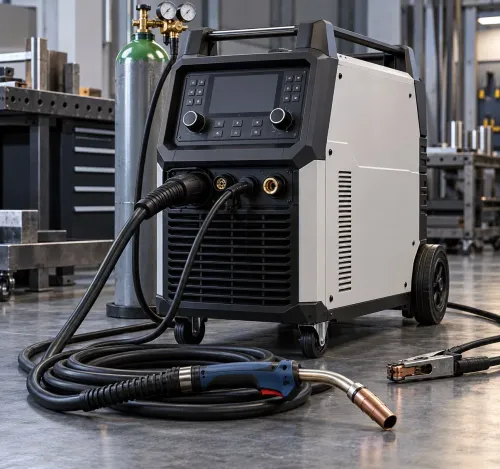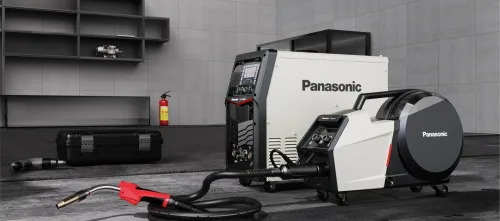
A Panasonic conical nozzle is not a universal fit: the correct choice depends on the torch front-end assembly, seating method, dimensions and welding process. By checking the old part, torch identification and mating components, you can order the right replacement and test it before production resumes.
Key takeaways
- Match the nozzle thread, seat, bore, and torch model before ordering.
- Replace nozzles with cracks, severe spatter buildup, distortion, or damaged threads.
- Install the nozzle with clean threads and verify shielding-gas coverage before welding.
- Record the torch model, nozzle code, batch details, and supplier for repeat orders.
What a Panasonic conical nozzle does and when its shape matters
A Panasonic conical nozzle directs shielding gas around the contact tip and arc, while its copper-based body shields the torch front end from heat and spatter. The cone improves access to tight joints, but its shape alone does not prove process suitability.
| Part or profile | What it does | Choice implication |
|---|---|---|
| Conical nozzle | Narrows toward the outlet and focuses access around the arc | Useful near joint features; the smaller opening reduces workpiece clearance and raises collision risk |
| Cylindrical nozzle | Maintains a broad, consistent opening | Gives more clearance around the arc but may restrict access |
| Tapered nozzle | Narrows gradually without necessarily matching a conical design | Confirm the actual outlet, length and seating dimensions |
| Gas diffuser | Distributes gas before it enters the nozzle | It is a separate mating component, not a substitute nozzle |
| Copper or copper alloy | Handles welding heat and resists electrical shorting better than many low-cost substitutes | Check grade, wall thickness and finish |
| Plated or aftermarket version | May change spatter resistance, cost and surface durability | Require stated material, plating and dimensions; do not infer them from the profile |
- Match the outlet and length to joint access, wire diameter, transfer mode and current range. A narrow outlet can foul against the workpiece or collect spatter sooner.
- For manual welding, prioritise visibility and clearance; for robotic or automated welding, confirm collision envelope, torch path and repeatable seating.
- Record the complete torch and machine identification before choosing a Panasonic conical nozzle. A mechanically compatible part can still disturb gas coverage and cause porosity.
How to confirm the correct nozzle fit before ordering
A catalogue entry that says “Panasonic conical nozzle” is not enough to confirm compatibility. Panasonic-compatible nozzles are not interchangeable across every torch family, so identify the complete assembly before ordering welding machine spares.
1. Record the welding machine and torch model, serial-number range, wire size, and the old nozzle’s part number or stamped marking. Read the torch model plate, then compare it with the machine manual and spare-parts diagram.
2. Measure and record the nozzle’s overall length, outlet diameter, inlet or thread dimensions, thread or seating style, shoulder geometry, and the gas diffuser’s position relative to the outlet. Photograph the old part from the side and take clear close-up photographs of the diffuser end and seating end.
3. Confirm the mating diffuser, insulator, retaining arrangement, and any O-ring or sealing component shown in the parts diagram. Check whether the replacement matches the contact-tip position, not just the nozzle’s outside diameter.
4. Send these records to the supplier and request confirmation of the exact part number before dispatch. Keep the written confirmation with the photographs.
Do not select a Panasonic conical nozzle by brand name or outside diameter alone. A nozzle can screw onto the torch while failing to seat against its shoulder; the result can be shielding-gas leakage, an off-centre gas stream, and poor alignment between the nozzle and contact tip.
Stop the order if the supplier cannot confirm the seating dimensions and diffuser relationship.
When to replace the nozzle and how to install it safely
Replace the conical nozzle when its outlet is distorted, blocked, cracked, burned through, or loose. Replace it if heavy spatter cannot be removed without damaging the bore, the threads are damaged, arc marks are visible, or turbulence and porosity keep recurring after gas flow and welding settings are checked.
Do not force a nozzle that resists removal. For safe conical nozzle replacement:
- Stop welding, let the torch cool, switch off welding power, and isolate the wire and shielding-gas supply.
- Remove loose spatter with a suitable tool. Do not hammer the nozzle or drive a sharp tool into its bore.
- Unscrew or release the old nozzle using the correct retaining method. If it binds, inspect for cross-threading or fused spatter before applying more force.
- Check the gas diffuser, insulator, contact tip, retaining clip or ring, O-ring, and nozzle seating surfaces for cracks, wear, distortion, contamination, or missing parts.
- Fit the new nozzle fully by hand. Confirm that the shoulder seats evenly and that the nozzle does not wobble; never use force to compensate for an incorrect thread or seating profile.
Before striking an arc, look through the nozzle for an unobstructed gas passage and confirm clearance around the contact tip. Apply gas and check for leakage at the nozzle and seating joint. Inspect the first weld for porosity, uneven shielding, and unstable arc behaviour before returning to production.
Keep the removed part and its markings with your welding spare parts records.
How to stop a replacement nozzle failing prematurely
Replacing the nozzle alone will not stop rapid failure if the welding cause remains. Excessive stick-out, a poor torch angle, incorrect shielding-gas flow, contaminated base material and unsuitable anti-spatter practice all increase spatter and gas turbulence, so the replacement Panasonic conical nozzle soon suffers the same damage.
Do not trust the flowmeter reading by itself. A dented rim or partially blocked outlet can disturb the effective gas pattern while the meter still shows the nominal flow, causing porosity, unstable arc behaviour and an inconsistent weld appearance.
Use this check instead of replacing the nozzle by calendar schedule:
- Inspect the outlet before each shift for dents, fused spatter, cracks and partial blockage. Clean it only with a method that will not enlarge or deform the bore.
- Confirm stick-out, torch angle, shielding-gas type and flow against the qualified welding procedure. Remove oil, rust, scale and moisture from the base material.
- Check the nozzle seating and gas passage for leakage, then run a short weld. Reject the nozzle if porosity or arc instability remains after the operating settings are corrected.
- Review anti-spatter dips and sprays before applying them. Do not use a product that leaves residue in the gas passage unless its compatibility with the nozzle, diffuser, liner, seal, welding process and consumable materials is confirmed. Residue can restrict gas flow and contaminate the weld.
How to source and record the right spare in Ahmedabad
Before dispatch, give the welding spare parts supplier enough evidence to identify the complete torch assembly, not merely “Panasonic conical nozzle.” For urgent local supply in Ahmedabad, send:
- Welding machine or torch model and serial-number range
- Old nozzle markings or OEM part number
- Thread and seating photographs, including the diffuser end
- Wire diameter and required quantity
- Existing diffuser, insulator, retaining method, and O-ring or seal details
Ask the supplier to identify the mating diffuser and confirm the nozzle’s dimensions, material, surface finish, and seating method. A nozzle that screws on but fails to seat can leak shielding gas or produce an off-centre gas stream.
| Description | What the supplier must state | What you must compare |
|---|---|---|
| OEM | Original part number and specified compatible models | Fit, sealing, heat resistance and service life |
| Authorised equivalent | Compatibility basis and approved replacement status | Outlet concentricity, materials and return policy |
| Aftermarket | Manufacturer, dimensions and stated compatibility | Total suitability, not unit price alone |
Ask Weld Tech Corporation to confirm these details before dispatch, just as you should with any local source; local stock saves downtime only after fit verification.
For repeat purchasing, keep a welding machine spares record containing the OEM part number, compatible torch and machine models, dimensions, material or finish, package quantity, and a clear seating-end photograph. This prevents a generic catalogue description from becoming the specification.
Related product
 | Welding Spare Parts We are Manufacturer, Distributor, Supplier of Welding Spare Parts View product → |
Frequently asked questions
What does a Panasonic conical nozzle do?
It directs shielding gas around the contact tip and arc while protecting the torch front end from heat and spatter. Its tapered shape can improve access to tight joints, but it does not prove suitability for every welding process.
How do I confirm a conical nozzle fits before ordering?
Check the torch and welding-machine model, then compare the nozzle code, thread, seating surface, bore, and overall dimensions with the existing part or manufacturer documentation.
When should I replace a Panasonic conical nozzle?
Replace it when cracks, distortion, damaged threads, heavy spatter, blocked gas passages, or an uneven gas shield affect welding performance.
How can I prevent a replacement nozzle from failing early?
Clean the threads and seating area, install the nozzle without cross-threading, remove spatter with the correct tool, and check that the nozzle is not distorted or obstructing the contact tip.
What information should I give a welding spare parts supplier in Ahmedabad?
Provide the torch and machine model, existing nozzle code, dimensions, welding process, photographs, quantity, and any batch or purchase records available.