The right regulator depends on more than whether it fits a Panasonic machine: you must match gas service, cylinder-valve connection, outlet control, flow range and hose connections. By the end, you will be able to decide whether the YX-24AT1DAA suits your job or whether another single-stage or two-stage option is safer and easier to control.
Key takeaways
- Match the regulator to your shielding gas and cylinder connection.
- Use the flowmeter range that matches your welding process.
- Choose single-stage regulation when outlet pressure variation is acceptable.
- Check pressure ratings, fittings and leaks before opening the cylinder valve.
Start with the welding process, gas and cylinder
A single-stage regulator is suitable when your welding process needs ordinary shielding-gas delivery and the outlet pressure can tolerate some change as the cylinder empties. Confirm the process, gas, cylinder and required flow before comparing Panasonic models.
1. Identify the process and gas. MIG or MAG may use argon, argon–carbon dioxide mixtures or carbon dioxide; TIG commonly uses argon or helium mixtures. Gas identity matters because the regulator must be rated for that service, and a carbon-dioxide cylinder does not behave like an argon cylinder as its contents fall.
2. Read the cylinder label and valve marking, then match the regulator’s cylinder connection exactly. Do not treat an adapter as a harmless shortcut: it can defeat gas-specific connection safeguards and add leak points. This is the first check in panasonic pressure regulator selection.
3. Calculate the flow your weld requires from the process, nozzle size, joint geometry, draft and gas type. A regulator’s maximum flow rating does not determine your setting; excessive flow creates turbulence that draws air into the shielding envelope, while insufficient flow causes porosity.
4. Confirm the regulator outlet connection matches the hose and machine inlet, and check the pressure rating against the required delivery pressure. The machine receives low-pressure gas through its hose; the regulator does not replace the machine’s solenoid or flow-control hardware.
Choose single stage pressure regulators for ordinary, short MIG, MAG or TIG work. Select two-stage regulation when long, high-volume welding demands steadier outlet pressure as cylinder pressure declines.
Read the two gauges and choose flow control correctly
The gauge nearest the cylinder shows cylinder pressure, indicating how much compressed gas remains. The second gauge shows outlet pressure when it is a pressure gauge, or gas flow in L/min when it is a flowmeter.
Do not treat pressure as flow: increasing outlet pressure to obtain more shielding gas can create turbulence or exceed the machine’s gas-valve rating.
| Gauge arrangement | What it tells you | Practical implication |
|---|---|---|
| Cylinder pressure plus outlet pressure | Supply pressure and regulated delivery pressure | You still need a separate flow-control device and a way to verify L/min |
| Cylinder pressure plus flowmeter | Supply pressure and delivered gas flow | Usually the clearest single-stage regulator option for MIG/MAG or TIG |
| Pressure gauge plus downstream flow control | Outlet pressure and adjusted flow | Works when the machine or hose assembly includes suitable flow control |
Compare the regulator’s 3 to 30 LPM scale with the welding procedure specification, machine manual and torch or gun requirement. A target of 12 LPM sits comfortably inside that range; set it at the required value, not automatically at 30 LPM.
A target near 3 LPM or 30 LPM leaves little adjustment margin, so choose a correctly scaled flowmeter for better repeatability.
For your welding pressure regulator choice, confirm that the flow reading uses the same gas and reference conditions stated by its manufacturer. Select the regulator by gas service, connections and required flow rather than by Panasonic machine model alone.
Choose single-stage or two-stage for the job duration
Choose a single-stage regulator for a short MIG, MAG or TIG job when the required flow remains within its rated range and cylinder pressure will not fall sharply during the weld.
These single stage pressure regulators reduce cylinder pressure in one step, making them practical for routine work where small outlet-pressure changes will not affect shielding.
| Regulator type | Outlet-pressure behaviour | Best fit |
|---|---|---|
| Single stage | Pressure changes more as cylinder pressure drops | Short welds, intermittent fabrication and ordinary shielding-gas delivery |
| Two stage | A second regulating step holds outlet pressure steadier as the cylinder empties | Long welds, high gas consumption and tightly controlled procedures |
A two-stage regulator provides better stability during continuous production because its second stage compensates for changing inlet pressure. That matters when a shift-long weld must maintain the same gas delivery, when excessive rechecking would interrupt work, or when inconsistent shielding could cause porosity and rework.
Use the actual job duration and gas consumption, not the Panasonic machine name, to make the choice. A single-stage regulator is adequate when you can tolerate checking the outlet setting as the cylinder pressure falls; it becomes a poorer choice when the cylinder may empty during one uninterrupted run.
Among single stage regulator options, select a flowmeter model when the procedure specifies L/min or CFH and the machine has no reliable external flow indication. Choose two-stage regulation when stable delivery is more valuable than the lower complexity and cost of a single-stage unit.
Verify every connection, pressure rating and installation detail
Confirm the YX-24AT1DAA against four interfaces and the site before connecting it: cylinder valve, gas, outlet hose, and machine inlet. Its 200 bar maximum inlet rating must exceed the cylinder’s maximum pressure at the expected site temperature, not just the pressure shown on a partly full cylinder.
Check these details on the cylinder, regulator label, hose and Panasonic machine manual:
- Match the cylinder-valve connection and thread standard exactly. Do not force a near-fit or add several adapters; each adapter adds a leak path and can defeat gas-specific safeguards.
- Confirm the regulator is marked for argon or the exact Ar-CO2 mixture in use. Never substitute oxygen-service or fuel-gas fittings because they appear mechanically similar.
- Match the regulator outlet connection to the hose end, then match the hose end to the machine’s gas inlet. The machine inlet receives low-pressure gas; the regulator does not replace the machine’s solenoid or flow control.
- Reconcile the outlet-pressure range with the machine manual, welding procedure specification and regulator instructions. Do not raise pressure to obtain more flow; excess pressure can overdrive the flowmeter, create turbulence or exceed the inlet rating.
- Check ambient temperature, ventilation, hose condition and clearance around the cylinder. Protect the assembly from heat, impact, oil and water.
During commissioning, use approved leak-detection fluid at the valve, seals, hose barb and O-rings—never a flame. Close downstream flow and watch for outlet-pressure creep. If pressure rises, remove the regulator from service. Weld Tech Corporation can verify these interfaces before a welding pressure regulator choice becomes an expensive mismatch.
Related product
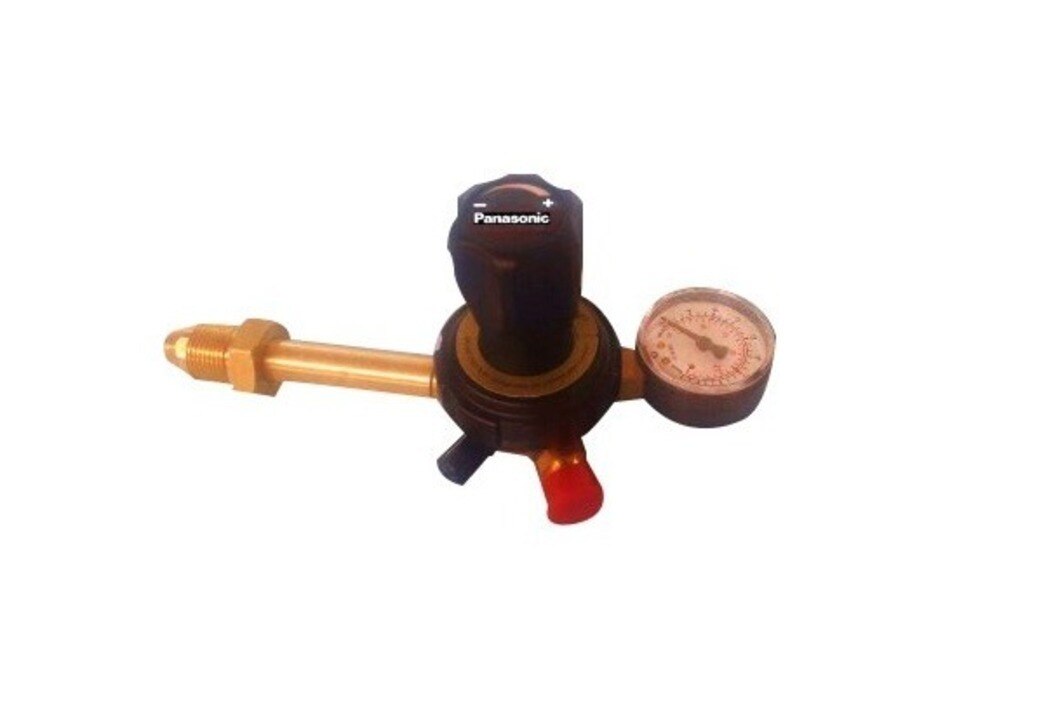
 | Single Stage Pressure Regulators Panasonic Single Stage Pressure Regulators Brand Panasonic Model YX-24AT1DAA Mounting Cylinder Mounted Gas Service Argon, Ar-CO2 mix Max Inlet Pressure 200 bar Nominal Flow Rate 3-30 LPM... View product → |
Use the regulator without creating flow, leak or freeze-up problems
Set outlet pressure to the welding machine’s specified inlet value, then adjust shielding-gas flow at the flowmeter—not by raising pressure. A high outlet setting can overdrive the flowmeter, create turbulent coverage, or exceed the machine’s gas-valve rating.
Before welding, run this operating check:
- Confirm the cylinder valve is fully open, then open it slowly while standing clear of the regulator face.
- Set flow within the regulator manufacturer’s range and place your intended rate near the middle of the scale. Compare the reading with the welding procedure specification, machine manual and actual torch or gun requirement.
- Trigger gas flow and check the hose, fittings and regulator body with leak-detection fluid. Bubbles identify a leak; never use a flame.
- Close the torch trigger and watch the outlet gauge. Pressure that keeps rising indicates regulator creep or a leaking seat.
- Check shielding gas at the torch or gun, not only at the regulator. A blocked diffuser, kinked hose or loose torch connection can reduce delivered flow.
Frost on the regulator body, an oscillating flow reading or flow that falls during a long weld indicates excessive gas demand, moisture, blockage or inadequate regulator capacity. Stop, close the cylinder and depressurise the downstream line safely; do not heat the regulator with a flame.
If the fault returns at the specified flow, revise the welding pressure regulator choice. Compare single stage regulator options by stable working flow, not maximum cylinder pressure alone.
Frequently asked questions
How do I choose a Panasonic single-stage regulator for welding?
Match the regulator to your welding process, shielding gas, cylinder connection, required outlet pressure and flow range.
What do the two regulator gauges show?
One gauge shows cylinder pressure; the other shows outlet pressure or gas flow, depending on the regulator design.
When is a single-stage regulator suitable?
Use one when ordinary shielding-gas delivery is required and outlet pressure variation as the cylinder empties will not affect the weld.
How can I prevent leaks and freeze-up?
Use compatible fittings, stay within pressure ratings, open the cylinder valve gradually, inspect connections and avoid creating unnecessary continuous flow.