A DC ARC hire package is more than an inverter: the useful specification includes leads, holder, return clamp, mains connection, polarity, safety checks and the accessories your site actually needs. By the end, you can separate the base equipment from chargeable extras, verify the 415 V three-phase connection and judge whether the package suits your electrodes, duty cycle and work environment.
Key takeaways
- Confirm the package includes electrode holder, work clamp, welding leads, and return cable.
- Match the machine’s input voltage, phase, breaker, and earthing requirements to site power.
- Use duty-cycle ratings to calculate how long you can weld before cooling pauses.
- Choose DC ARC for suitable steel and repair work; reject hire when the process needs AC or specialised control.
What arrives in a standard DC ARC rental package?
A standard DC ARC rental package arrives as a constant-current inverter power source plus the parts needed to strike and maintain an arc. A welding equipments rental inverter controlled dc arc package normally includes:
- Electrode holder, work-return lead, clamp, welding leads, input cable or plug, protective-earth connection and polarity terminals
- Carrying frame or trolley, enclosure, and a case or basic tool kit when specified
- Mains switch, output sockets and cable lugs ready for connection
| Base hire | Normally included | Extra or confirm separately |
|---|---|---|
| Power source and leads | CC inverter, holder, return clamp, input connection, earth connection, polarity terminals | Extension cables or different lead lengths |
| Handling and protection | Frame or trolley, case, basic tools | PPE, grinder, welding screens, fume extraction and fire controls |
| Consumables and logistics | None unless written into the quotation | Electrodes, gas cylinders, regulators, delivery and collection |
Long leads and undersized conductors increase voltage drop, cable heating and arc instability. Ask for each lead’s length and conductor size before accepting a package.
Inspect every item at handover. Check insulation for cuts, cable lugs for looseness, switches and plugs for damage, the enclosure for cracks, and the holder and return clamp for secure, clean contact.
Electrodes are not interchangeable. The quotation must state classification, diameter, quantity, packaging condition and DCEP or DCEN polarity. Low-hydrogen rods need dry storage or a documented rebake arrangement; damp electrodes can raise hydrogen-assisted cracking risk.
How do you prove the site can power the rented machine?
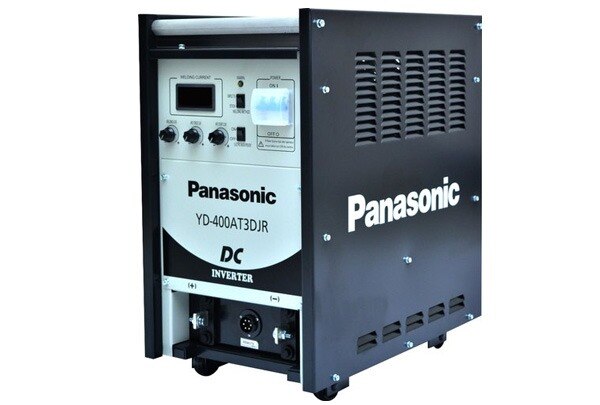
Treat the YD-400AT3 DJR rental as a 415 V three-phase load, not as a high-output machine that can use an ordinary 230 V outlet. Before dispatch, have a qualified electrician verify the site distribution board, the machine nameplate frequency, and the complete mains connection.
- Measure voltage between each phase pair and confirm the required three-phase value; confirm the supply frequency matches the nameplate, such as 50 Hz.
- Install a dedicated protective device sized from the nameplate input current, with the specified breaker rating and curve.
- Check the upstream cable conductor size, insulation condition and route; long or undersized runs cause voltage drop and heating.
- Match the machine plug configuration, socket or isolator, and phase sequence to the site connection.
- Measure phase balance under load and test protective-earth continuity from the board to the machine frame.
- Confirm earth-fault protection is suitable for the inverter and that any extension lead stays within the permitted length.
The quotation must state whether the input cable, plug, isolator and temporary distribution board are supplied or customer-provided. A 200–250 A DC arc output describes welding current, not mains compatibility.
For generator use, confirm stable voltage and frequency, adequate continuous capacity, power-factor compatibility and a welding-mode rating. Do not size the generator from maximum welding amps alone.
Request VRD status separately. A voltage-reduction device lowers unloaded electrode voltage and restores welding voltage on contact; that is not the same as ordinary open-circuit voltage. Include these checks in every DC arc equipment rental approval.
How do current range and duty cycle change the work you can complete?
A 20–400 A range is a control limit, not a normal 400 A setting. Start with the electrode manufacturer’s data sheet and welding procedure, then match rod diameter, coating type, welding position and plate thickness. Use these figures only as practical starting points:
| Rod diameter | Typical starting current | Suitable work |
|---|---|---|
| 2.5 mm | 60–90 A | Thin sections, light repairs and positional welding |
| 3.2 mm | 90–130 A | General fabrication and medium plate |
| 4.0 mm | 130–180 A | Thicker plate and structural members |
| 5.0 mm | 180–240 A | Heavy sections with adequate joint access |
The final setting still depends on joint design, root gap and preheat. Larger rods do not automatically produce a sound weld; excessive current can increase undercut, distortion and burn-through.
Confirm electrode compatibility and polarity before dispatch. DCEP and DCEN alter penetration and arc behaviour, so connect the holder and return lead exactly as the electrode data sheet specifies.
A 60% duty cycle means six minutes of arc-on time in a ten-minute period, followed by four minutes of cooling, at the stated test current and ambient temperature.
It does not mean six minutes at 400 A. Higher current increases heat load and reduces permitted arc time; lower-current work normally allows longer runs, subject to the nameplate curve and clear cooling airflow. Record the test current, ambient basis and cooling instructions at handover.
Which jobs suit DC ARC, and when is inverter hire the wrong choice?
Choose DC ARC (MMA) for outdoor repair, structural steel, maintenance and sites where wind would disturb a shielding-gas envelope. An inverter arc welding hire package needs no gas bottle to protect the arc.
| Process | Strength | Limitation |
|---|---|---|
| DC ARC/MMA | Outdoor repair, structural steel and maintenance | Stick welding is harder on thin sheet, which increases distortion and burn-through |
| MIG/MAG | Long production runs and continuous wire feed | Needs shielding gas, cylinder, regulator, flow control and wind protection |
| TIG | Precise welds and controlled heat input | Needs amperage control, gas management and specialised accessories |
| Engine-driven welder | Remote sites without dependable mains power | Fuel, noise, exhaust and generator maintenance become part of the job |
MMA can weld stainless steel with the correct electrode, polarity and procedure. Aluminium usually needs specialised electrodes and technique; it is not a straightforward stick-welding substitute.
A DC ARC package is the wrong choice for continuous high-duty production, automated wire-feed work, or a site without suitable three-phase power or a compatible engine-driven supply. Choose MIG/MAG for long runs, not a stick electrode that needs frequent changes.
Do not treat a CC inverter’s scratch-start or lift-TIG function as full TIG capability. If TIG is required, list the torch, gas hose, regulator or flowmeter, tungsten and remote control in the quotation. High-frequency start, crater control and precise gas management must be confirmed separately; “DC ARC” does not include them.
What should you compare before accepting an arc power source rental?
Compare an arc power source rental by operating fit, site risk and handover condition, not daily price or maximum amperage.
Require the quotation to state the constant-current output range, duty-cycle test current and ambient temperature, open-circuit voltage, polarity selection, electrode diameters and classifications, input phase, voltage and frequency, maximum input current, VRD status, lead lengths and conductor sizes, machine weight, carrying frame or trolley, IP rating, cooling requirements and generator compatibility.
| Item | Record in the quotation | Why it matters |
|---|---|---|
| Power source | CC range, duty-cycle test point, open-circuit voltage, polarity and VRD | Confirms the machine suits the electrode and work cycle |
| Site connection | Phase, voltage, frequency, maximum input current and generator conditions | Prevents an unsuitable board, cable or generator connection |
| Physical package | Lead lengths and sizes, weight, frame or trolley, IP rating and cooling clearance | Exposes handling limits, voltage drop and overheating risks |
| Extras | Electrodes, extension leads, PPE, grinder, screens, extraction, gas equipment, delivery and collection | Separates included items from chargeable items |
Ask for the service condition, inspection date, electrical-safety or calibration records where applicable, and written confirmation that the mains cable, holder, return clamp, plugs and enclosure passed handover inspection. Weld Tech Corporation can prepare a package-specific quotation for Pune site conditions instead of a generic rate.
Accept the machine only after you:
- Verify the distribution board and generator arrangement.
- Match electrode classification, diameter and polarity.
- Test the return connection.
- Photograph every delivered accessory.
- Record who controls cooling pauses and consumable storage.
Related product
 | DC ARC Welding machine Inverter Controlled DC ARC Welding MODEL YD-400AT3 DJR INPUT SUPPLY 415 + - 20% PHASE / FREQUENCY THREE / 50-60 HZ POWER CONSUMPTION 17.6 KVA/16.7 KW WELDING CURRENT RANGE 20-400AMP... View product → |
Frequently asked questions
What arrives in a standard DC ARC rental package?
A standard package includes a constant-current inverter power source, electrode holder, work clamp, welding leads, return cable, and power connection details. Confirm whether electrodes, extension cables, PPE, and transport are included because rental packages differ.
How do you prove the site can power the rented machine?
Compare the machine nameplate with the site supply. Check input voltage, single- or three-phase operation, rated input current, plug type, breaker capacity, cable size, and protective earthing before delivery.
How do current range and duty cycle change the work you can complete?
The current range limits electrode sizes and material thicknesses. Duty cycle states how long the machine can weld within a ten-minute period at a specified output before it needs cooling.
Which jobs suit DC ARC, and when is inverter hire the wrong choice?
DC ARC suits repair, maintenance, structural work, and fabrication with compatible electrodes. Hire a different process when the job needs AC output, TIG high-frequency starting, wire-feed MIG or FCAW, aluminium capability, or tightly controlled automated welding.
What should you compare before accepting an arc power source rental?
Compare output range, duty-cycle rating, input supply, electrode diameter limits, lead lengths, included accessories, machine condition, inspection records, replacement terms, delivery, collection, and operator support.