The right choice depends on more than a machine’s maximum amperage: material, thickness, joint volume, shielding gas, electrical supply and duty cycle all determine whether MIG will improve your workshop’s output. By the end, you will be able to match a Panasonic system to the work, reject unsuitable alternatives and define a practical acceptance test before purchase or rental.
Key takeaways
- Choose MIG for repeated joints needing continuous wire and high deposition.
- Use MAG for carbon steel when an active-gas blend suits the weld.
- Match wire diameter, polarity, shielding gas and amperage to material thickness.
- Check power supply, ventilation, wire capacity and duty cycle before purchase or rental.
When MIG is the right process for your workshop
MIG is the right process when your workshop repeats carbon-steel, stainless-steel or aluminium joints and benefits from continuous solid wire, higher deposition and fewer electrode changes than SMAW. Its strongest mig welding machine applications combine repeatable settings with sustained wire feeding rather than isolated repairs.
Choose MIG when:
- Thin sheet needs controlled heat input, or medium sections require faster filling than manual electrodes provide.
- Short production runs justify quick setup, while high-volume fabrication gains from continuous feeding and consistent bead placement.
- Work is indoors or shielded from drafts, because wind can displace shielding gas and create porosity.
- The required finish includes a consistent bead appearance with limited cleanup.
- Joint positions include flat, horizontal or overhead work that matches the selected transfer mode.
Short-circuit transfer suits thinner material and awkward positions because its lower heat input reduces burn-through. Spray or pulsed transfer suits compatible thicknesses and higher deposition, but only with matching wire, shielding gas, current, voltage and machine functions; spray is not a universal replacement for short-circuit welding.
MIG is most attractive when repeatable settings and reliable wire feeding matter across a production pattern. It is less attractive for scattered outdoor repairs without dependable gas protection, where wind, repositioning and frequent setup can erase its productivity advantage.
For industrial mig welding, confirm the material range, thicknesses and positions with representative weld trials before selecting the machine.
MIG, MAG and the alternatives: which process fits the job?
MIG uses an inert shielding gas such as argon or helium, while MAG uses carbon dioxide or an active gas mixture. Gas chemistry changes arc stability, penetration and spatter, so it also determines suitable material, wire classification, polarity and transfer mode. Do not select a wire before matching it to the gas and procedure.
| Option | Main advantage | Better choice |
|---|---|---|
| Panasonic MIG welder | Continuous wire, controlled settings and clean indoor production | Repeated carbon-steel, stainless-steel or aluminium joints in industrial MIG welding |
| SMAW (stick) | No shielding-gas cylinder and tolerates outdoor work | Infrequent repairs, remote jobs or windy sites |
| TIG | Precise, low-spatter welds | Thin, visible or appearance-critical components |
| Flux-cored welding | High deposition, with outdoor-capable options | Heavy fabrication or windy conditions when the selected wire and procedure support it |
| Compact single-phase inverter | Low infrastructure cost and portability | Light work where output and production rate are modest |
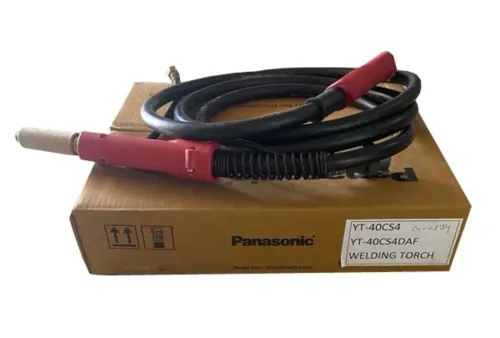
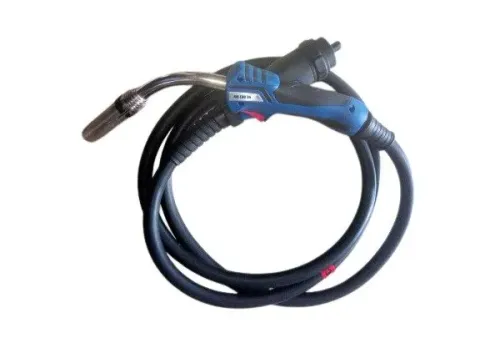
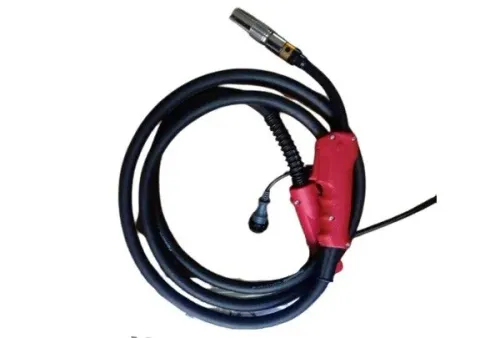
Compare the complete package, not the amperage: feeder, torch, liner, contact tips, drive rolls, regulator and local service support determine whether wire feeding stays reliable.
A conventional manual system suits varied assemblies, repairs and changing fixtures. An integrated Panasonic TAWERS robotic cell combines robot motion, welding power and wire feeding for stable fixtures, repeatable joints and high utilisation; it is a poor investment for scattered repair work or constantly changing parts.
How to match current, wire, gas and settings to the weld
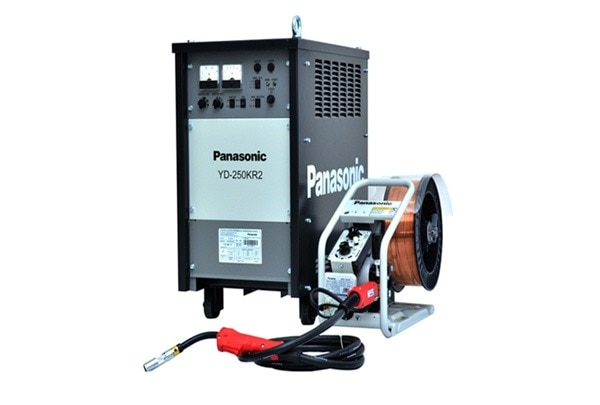
The YD-250KR’s 50–250 A and 15–27 V are operating windows, not universal recipes. Start at the lower end with suitable wire speed for thin sheet; thicker sections need enough deposition, fusion and travel time to avoid cold lap or lack of penetration.
1. Select wire diameter and grade first. A 0.8 mm ER70S-6 copper- or copper-alloy-coated wire suits many carbon-steel joints; stainless steel and aluminium require the correct stainless or aluminium classification. Set polarity from the wire manufacturer’s procedure, not from the machine label alone.
2. Match wire-feed speed to current: increasing feed usually increases current and deposition. Set voltage to control arc length and bead width; excessive voltage produces a long, wandering arc, while too little causes stubbing. Adjust inductance or arc control for short-circuit smoothness, then check travel speed, stick-out and bead shape.
3. Choose shielding-gas flow from nozzle size, joint access and surrounding conditions. Check leaks, drafts, blocked diffusers and excessive turbulence; excessive flow can draw air into the weld and create porosity. Do not treat a higher flow rate as better protection.
4. Match the liner, contact tip and drive-roll groove to the wire diameter and material. Aluminium needs a low-friction liner and usually a spool-gun or push-pull arrangement; a long standard steel-wire torch commonly causes bird-nesting.
Use representative coupons and change one variable at a time. Record the validated recipe—wire, polarity, gas, flow, travel speed and settings—for repeatable Panasonic MIG welding machine work, rather than treating published figures as factory settings.
Can the workshop support the machine and its production duty cycle?
A 415 V three-phase requirement is a procurement constraint, not a detail to solve after delivery. Compare the machine nameplate with the building’s single- or three-phase service, breaker capacity, cable size, earthing, phase balance, voltage stability and generator compatibility before ordering. Undersized wiring or unstable voltage causes nuisance trips and poor arc performance.
| Check | Confirm before purchase | Risk if mismatched |
|---|---|---|
| Supply | Phase, voltage, rated input current and permissible variation | Trips, weak arc or equipment damage |
| Installation | Breaker, cable size, earthing and phase balance | Overheating or unsafe fault protection |
| Generator | Continuous capacity, voltage regulation and compatibility | Unstable output during welding |
Duty cycle is the percentage of a 10-minute period during which the machine can weld at a stated output and ambient temperature. A 60% rating means 6 minutes welding followed by 4 minutes cooling at that test condition.
Higher ambient temperature reduces thermal headroom; exceeding the rating triggers thermal protection, forced pauses and slower production, not extra output. Verify the exact model’s IEC 60974-1 rating plate and manual at your intended current.
Provide local fume extraction, UV screens, cylinder restraint, hot-work controls, suitable respiratory protection where required and fire prevention. Before approval, run a representative acceptance test using the actual material, thickness, wire, gas, joint positions and production sequence; inspect fusion, bead profile, porosity and spatter, record wire-feed interruptions, and monitor thermal behaviour.
This proves whether the industrial MIG welding system can sustain your real duty cycle.
What should you specify before buying or renting a Panasonic system?
Approve the package only after it matches your production cycle, not after a no-load arc demonstration. Specify every interface before ordering a Panasonic MIG welder:
- Name the exact power source and feeder, then state torch rating and length, wire diameter, drive-roll groove, liner, contact tips, regulator, gas connection, earth lead, extension requirements and protection settings.
- Run representative welds using the planned material, thickness, wire, gas, joint positions and transfer mode. Inspect fusion, bead profile, porosity and spatter; record wire-feed interruptions and thermal behaviour throughout the intended cycle.
- Reject an incomplete package. A correct amperage rating cannot compensate for the wrong liner, blocked gas path, incompatible roll groove or an extension lead that causes voltage drop and nuisance protection trips.
Rental makes sense for a shutdown, overflow production or process trial when you can define output, duty cycle and accessories in advance. Put the machine model, torch specification, wire, rolls, regulator, gas connection and earth lead in the rental order, and state who pays for damaged consumables.
For a Panasonic MIG machine in Mumbai, confirm local stock of the exact liners, tips, drive rolls, torch parts and control boards, plus repair and calibration service. Weld Tech Corporation can help define that Panasonic package, its accessories and support requirements; imported equipment does not guarantee local spares.
Code work still requires the governing procedure, qualified welders, inspection and traceability under ISO 3834-2 or AWS D1.1 where applicable.
Related products
 | MIG Welding Machines Panasonic MIG Welding Machines Brand Panasonic MODEL YD-250KR 2 INPUT SUPPLY 415 +10% ,-10% PHASE/FREQUENCY THREE / 50-60 HZ POWER CONSUMPTION 9.5 KVA/7.9KW WELDING CURRENT RANGE... View product → |
 | MAG Welding Machines Panasonic MAG Welding Machines Brand Panasonic Model YD-350GZ4 Phase 3-Phase Current 350 A Voltage 380-415 V Dimension (L x B x H) 380x550x640 mm Product Type New Duty Cycle 60%... View product → |
Frequently asked questions
When is MIG the right process for a workshop?
MIG suits repeated carbon-steel, stainless-steel or aluminium joints where continuous solid wire, higher deposition and fewer electrode changes improve production.
What is the difference between MIG and MAG welding?
MIG uses an inert shielding gas such as argon or helium, while MAG uses an active gas such as carbon dioxide or an argon-CO2 blend. MAG is widely used for carbon-steel fabrication.
How do you match wire, gas and settings to the weld?
Select wire material and diameter for the base metal and joint thickness, then set polarity, shielding-gas flow, voltage, wire-feed speed and amperage using the wire manufacturer's procedure data.
What should a workshop check before buying or renting a Panasonic MIG machine?
Confirm input power, output range, duty cycle, wire-spool capacity, torch reach, gas supply, ventilation, service access and the machine's fit with your planned production workload.
Related products
 | Welding machine Panasonic Inverter Welding Machines Brand Panasonic MODEL YD-400RX 1 INPUT SUPPLY 415 +10% -20% PHASE THREE /50-60HZ POWER CONSUMPTION 16.2KVA/15.6KW WELDING CURRENT RANGE 50-400AMP... View product → |
 | TIG Inverter Welding Machines Panasonic TIG Inverter Welding Machines Brand Panasonic MODEL YC-400TX3 INPUT SUPPLY 415 + - 10% PHASE/FREQUENCY THREE / 50-60 HZ RATED INPUT CAPACITY 13.9 KVA/13.2 KW RATED OUTPUT CURRENT... View product → |